
I could quite easily write a blog just about sandwiches. From a Classic Club to a Banh Mi, a Cucumber Sandwich to a Spanish Omelette Bocadillo, there are endless fantastic variations just waiting to be recreated. But my latest obsession has been a perfect Salt-beef Sandwich. I have been reading a lot about The Rubens Sandwich and I wanted to give it a go. So last week I put a fantastically cheap piece, of the somewhat neglected cut, brisket into Brine and now it is now bubbling away gently on the stove, as I write.
The first meal will be a simple supper, as Nigel Slater would say, of poached salt-beef with just the accompaniment of some boiled New Potatoes, Carrots and Celery from the pot and some horseradish or mustard. In fact I think I have some beetroot in the fridge left, from my Riverford Vegetable Box so I might knock up some Chrain - Horseradish and Beetroot Relish.
I have made this Salt-beef recipe (or corned beef as they call it in Ireland and across the pond) many times before and it is from the fabulous “Charcuterie, The Craft of Salting, Smoking and Curing” by Michael Rehlman and Brian Polcyn.
I am very keen to invest in a Smoker for my back garden. Ever since giving up smoking a few years ago, I have been constantly drawn towards products which are smoked in some sort of desperate, nostalgic recreation of this lost pastime of my youth. Instead of sitting on the deck in my back garden smoking, I have images of sitting feeding exotic woodchips into my smoker before tucking into home-smoked Hickory Mackerel and Maple Cured Smoked Bacon. In the meantime, I am still saving up for this expensive piece of kit. Well, at least the ones I have my eye on are. It’s a tossup between the Weber 47cm Smokey Mountain Cooker or a ProQ Frontier at the moment, and if anyone out there has any advice into helping me make up my mind, your comment would be very much appreciated.
But back to my sandwich. There are many questionable stories into the history of The Reuben’s sandwich which is basically melted Swiss cheese, sauerkraut, Thousand Island or Russian dressing and salt-beef, in toasted rye bread. But I wanted to know how it held up to my all time favourite of salt-beef, half/half mustard (half American - sweet, and half English - for the kick) and loads of pickle cucumbers, also on Rye.
I made up my Reuben’s, and I have to say it was damn fine. The only thing I wasn't sure about is the Sauerkraut but I reckon that is because it is shop bought and not home made. I tried my own favourite again. That was damn fine too. And then I had an idea. The ultimate Salt-beef sandwich. Just put everything in it - so I did, and it was fantastic! Here it is. The first ever recipe for "The Melman" -The Ultimate Salt-beef Sandwich.
I felt I needed to work on the Sauerkraut. The best I had managed to find was Krakus, in my local polski sklep but it wasn't great. Sauerkraut is cabbage with has been fermented and also, more importantly in times before refrigeration, preserved. It is immensely popular in many European countries including Germany and Poland but also Alsace, where the name comes from, and France where it appears in the famous dish, Choucrout Garni. This is a substantial meal with the addition of sausages and potatoes. The very thing to sustain you through the cold winter months.
The fermentation process in the cabbage produces Lactic Acid Bacteria and therefore is Bioactive and probiotic like those expensive little drinks such as Yakult. Interestingly there are versions of recipes based on fermented cabbage from all round the world. Kimchi from Korea, Tsukemono from Japan, Suan Cai from China and Atchara from The Filipinos.
The recipe I have used is in the very same book I was using for the salt-beef. I have always been slightly put off by the thought of fermenting barrels of cabbage out-side my back door, but this recipe sounded fairly straightforward, so I decided to give it a go. It is one week into its two week fermentation and looking good. I will let you know how it turns out.
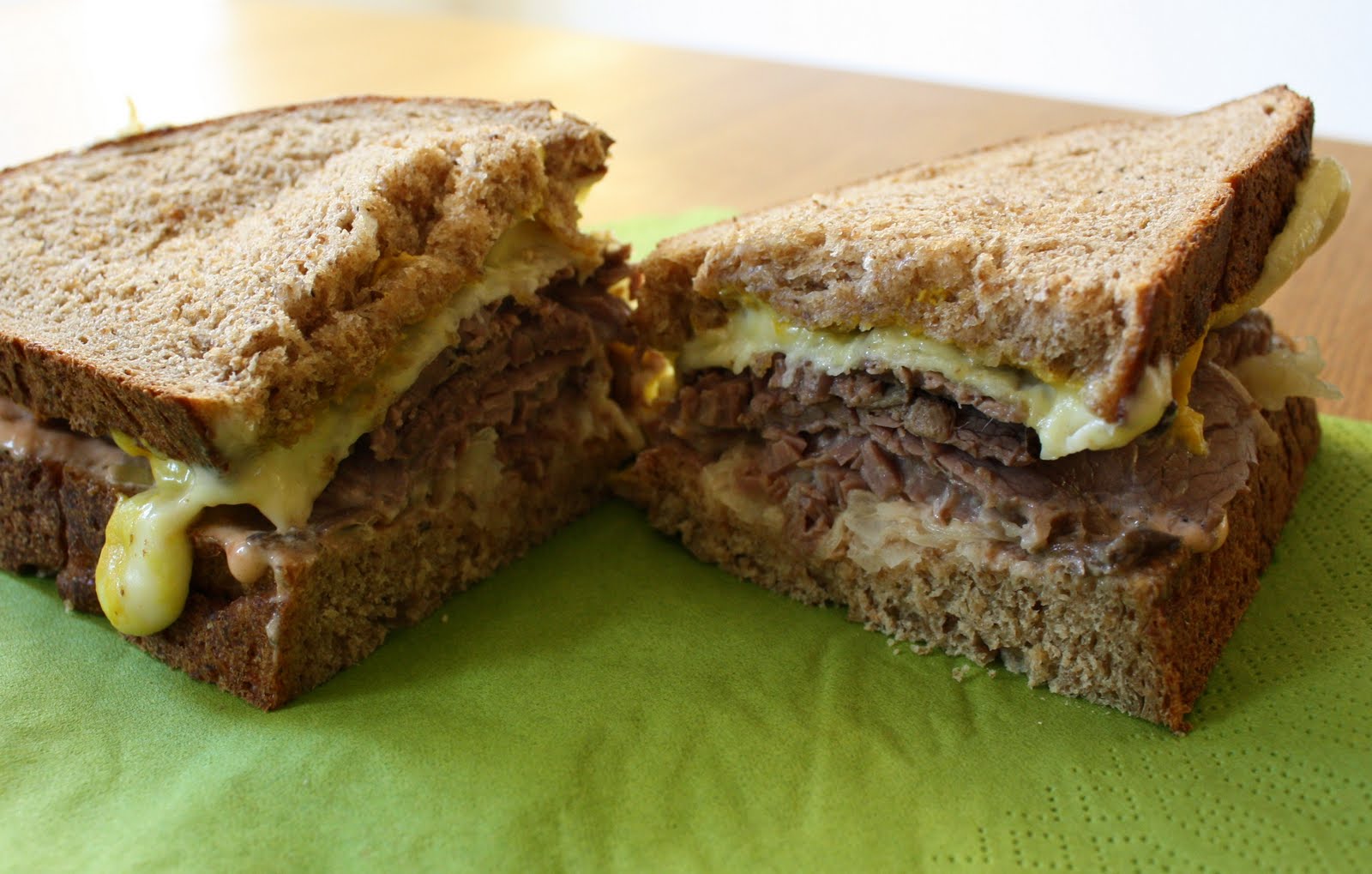
The Melman (The Ultimate Salt-beef Sandwich)
Rye Bread - Cucumber Pickle Juice Rye loaf
Salt Beef
Pickle Cucumbers (Sweet and Sour)
English Mustard
American Mustard (French's Classic Yellow)
Swiss Cheese
Sauerkraut
Thousand island dressing
Pickle Cucumbers (Sweet and Sour)
English Mustard
American Mustard (French's Classic Yellow)
Swiss Cheese
Sauerkraut
Thousand island dressing
Butter one side of your slices of bread and place the slices buttered-side down on a large piece of wax paper on a flat surface. Spread with half/half of the mustards. Top with a slice of Swiss cheese. Cover in slices of dill pickle and then slices of salt-beef. Using paper towels, squeeze out excess moisture from the sauerkraut. Top with sauerkraut. Add another layer of salt-beef and a second slice of Swiss cheese to each sandwich. Coat the second piece of bread with thousand island and place dressing side down on top of the cheese. Butter the side facing out.
Preheat a griddle or frying pan to medium heat. Cook the sandwiches on one side until the bread is golden brown. Use a spatula to carefully flip the sandwiches over and finish cooking on the second side. Cut the sandwiches in half before serving.

Sauerkraut
The Brine - 4 litres water and 3/4 cup plus 2 tablespoons / 200g Kosher salt
1 green cabbage, about 3lbs / 1.5 kg, shredded or thinly sliced.
Combine the water and salt in a small pot and bring to a simmer, stirring to dissolve the salt. Remove from the heat and let cool, then chill. Combine the cabbage and brine in nonreactive container. Cover the cabbage with a piece of cheesecloth or a clean kitchen towel. Weight the cabbage and cloth down with a plate, pressing down so that the cabbage is completely submerged. Cover loosely with cling film and set in a cool place for 2 weeks (no hotter than 70 to 75 degrees F. / 21 to 23 degrees C. or non beneficial bacteria can begin to thrive.) Drain the cabbage, reserving the brining liquid; the cabbage should have a pleasant sour-salty flavour and although its green colour will have paled, it should still be crunchy. Strain the braising liquid into a pot and cover and refrigerate the cabbage. Bring the brining liquid to a boil. Remove from the heat and let cool to room temperature, them chill. Pour enough of the cold brine over the sauerkraut to cover it completely; discard the extra brine. Store, covered in the refrigerator for up to 3 weeks.
Thousand Island Dressing
Mayonnaise
Tomato Ketchup (a good quality one if possible)
Lemon Juice
Tabasco
The mix is up to you.
The Brine - 4 litres water and 3/4 cup plus 2 tablespoons / 200g Kosher salt
1 green cabbage, about 3lbs / 1.5 kg, shredded or thinly sliced.
Combine the water and salt in a small pot and bring to a simmer, stirring to dissolve the salt. Remove from the heat and let cool, then chill. Combine the cabbage and brine in nonreactive container. Cover the cabbage with a piece of cheesecloth or a clean kitchen towel. Weight the cabbage and cloth down with a plate, pressing down so that the cabbage is completely submerged. Cover loosely with cling film and set in a cool place for 2 weeks (no hotter than 70 to 75 degrees F. / 21 to 23 degrees C. or non beneficial bacteria can begin to thrive.) Drain the cabbage, reserving the brining liquid; the cabbage should have a pleasant sour-salty flavour and although its green colour will have paled, it should still be crunchy. Strain the braising liquid into a pot and cover and refrigerate the cabbage. Bring the brining liquid to a boil. Remove from the heat and let cool to room temperature, them chill. Pour enough of the cold brine over the sauerkraut to cover it completely; discard the extra brine. Store, covered in the refrigerator for up to 3 weeks.
Thousand Island Dressing
Mayonnaise
Tomato Ketchup (a good quality one if possible)
Lemon Juice
Tabasco
The mix is up to you.


